Why Tennis & Padel Balls Go DeadThe Science Behind Pressure Loss
New balls start losing internal pressure the moment the can is opened. Here is what is actually happening inside and why it matters for your game.
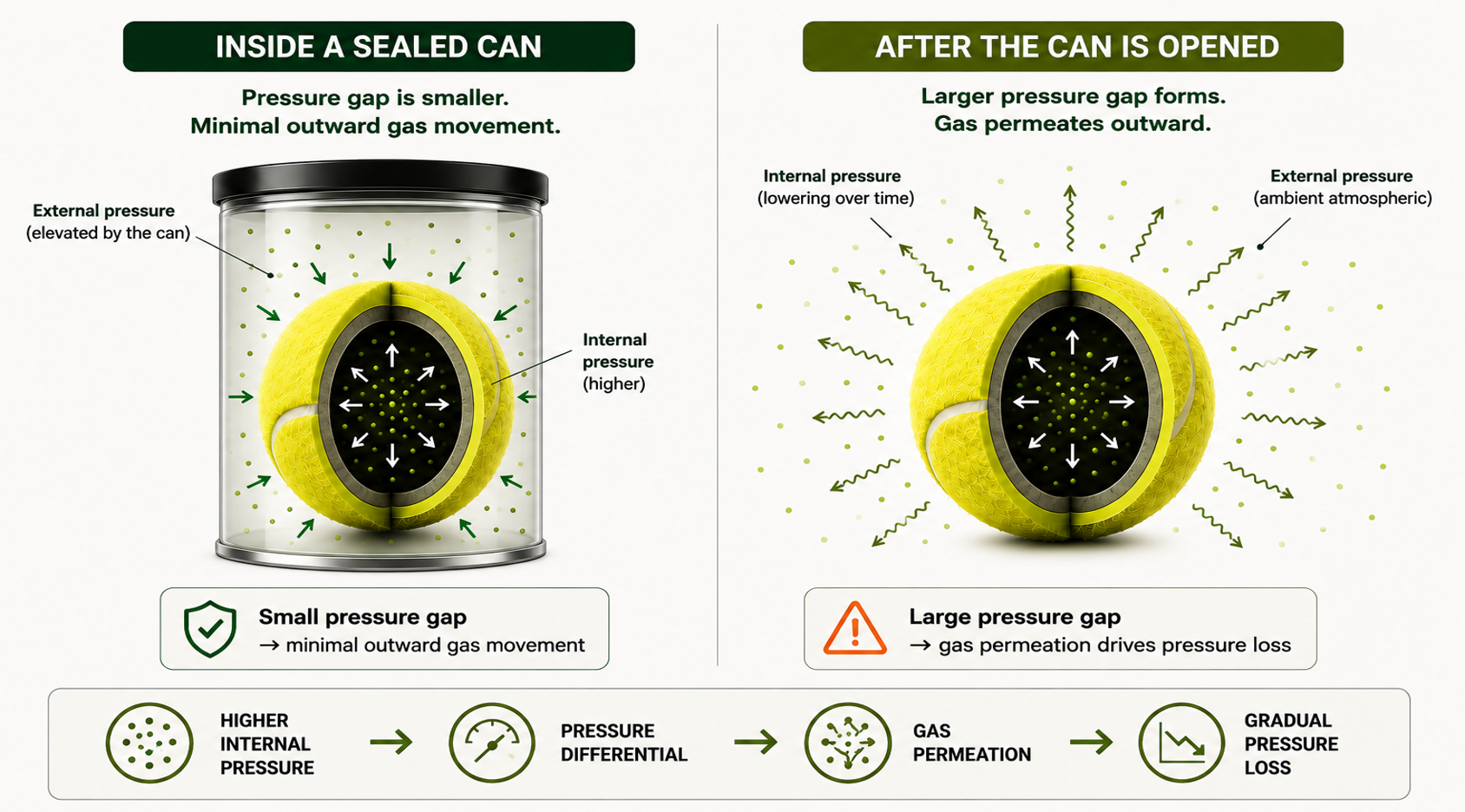
That sharp psshht when you crack open a fresh can of tennis or padel balls is the sound of a sealed environment equalizing with the room around it. New balls start losing their internal pressure the moment their sealed can is opened, as their higher pressure seeks equilibrium with the ambient. This pressure reduction, combined with racket impacts during play, degrades the ball's ability to rebound. A few sessions later, the same ball can feel noticeably different: lower rebound, less pop off the strings, a duller response on contact. The felt may still look clean. Nothing about the outside has to change for the inside to be different.
Pressure loss is the main driver of the “dead” feel. It continues even while the ball is stored, while repeated impacts during play may contribute to pressure loss. Rubber fatigue, and felt wear can also affect the ball performance, but they are separate processes.
Why do tennis and padel balls start losing pressure after the can is opened?
Pressurized tennis and padel balls contain gas at a higher internal pressure than the ambient pressure. Factory cans are pressurized to a level similar to the balls’ internal pressure, helping maintain their pressure during storage. Once the can is opened, that protective environment is replaced by ambient conditions, and gas gradually moves through the rubber wall toward equilibrium. The resulting imbalance between the ball’s interior and the outside atmosphere is called a pressure differential. It drives gas permeation, the gradual movement of gas through the rubber wall. Rubber permeability describes how readily the material allows that movement.
Research by Cubitt and Bramley (2006) indicated that tennis balls lose pressure during storage, even without play. A ball sitting untouched in your gear bag loses playability just as steadily as one stored on a shelf. This matters because recreational balls spend far more time at rest than at play. Someone who plays 2 hours per week leaves those balls in storage for the remaining 166 hours of the week.
How play affects ball pressure and rebound?
During play, every racket strike and every court rebound compresses and deforms the ball. Every rally adds another cycle, and a single session creates dozens of them for each ball. Over time, these repeated cycles can contribute to mechanical aging and changes in ball properties. This is separate from the pressure loss that continues between sessions, so a ball's condition reflects both time and use.
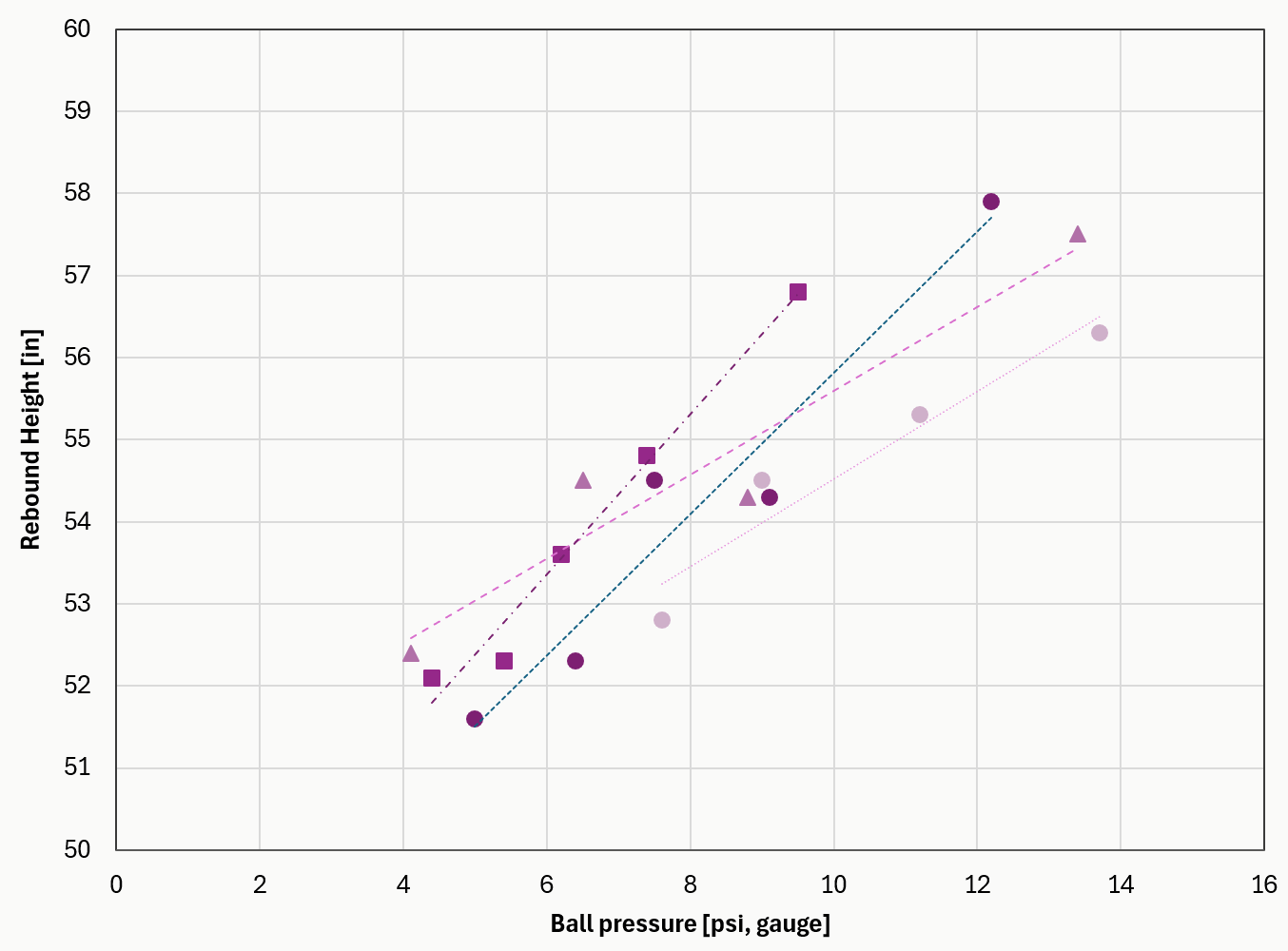
Figure 2 shows the relationship between ball pressure and rebound height for different ball brands and pressure levels (Dillon, Simonutti, 2024). Rebound was measured by dropping each ball from a height of 100 inches, according to the requirements for approved balls (ITF, 2026). A 22–35% decrease in ball pressure caused a 4–6% decrease in rebound height.
Why tennis and padel balls feel "dead"?
A ball feels "dead" primarily when its internal pressure drops, forcing the rubber core to absorb impact energy rather than spring back efficiently. Players usually recognize a dead ball before they can explain it. A pressurized ball has an elastic rubber core filled with compressed gas. On impact, both the rubber and the gas resist deformation and help the ball regain its shape. As internal pressure falls, that resistance decreases, allowing the ball to deform more and reducing its rebound and response.
According to the research on player perception and ball degradation conducted by Davies and Steele, the transition from a "new" to a "dead" ball is associated with a shift from a "hard and light" (lively) feel to a "heavy and soft" sensation. Without optimal internal pressure, the ball deforms excessively on impact and absorbs energy rather than returning it.
Sports engineers have quantified this mechanical loss. Haake, Carré, and Goodwill (2003) found that puncturing a pressurized tennis ball reduced its coefficient of restitution by 20% and its dynamic stiffness by 35%. Dynamic stiffness describes how strongly a ball resists deformation during a rapid impact. In simpler terms, the pressure loss of the ball significantly changed the way it behaved during impact, reducing its rebound, pressure, and response, even though its appearance did not necessarily change.
Pressure loss vs. felt wear: what is the difference?
Pressure loss is the main internal cause behind declining rebound in pressurized balls, but felt wear and mechanical aging can also affect performance. Repeated deformation can fatigue the rubber core over time, separately from pressure loss. For players, however, the clearest distinction is between invisible pressure loss and visible felt wear (Table 1).
| Factor | Pressure loss | Felt wear |
|---|---|---|
| Location | Inside the rubber core | Outside surface |
| Visibility | Usually invisible | Usually visible |
| During storage | Continues | Minimal |
| Main effects | Rebound, deformation, response | Aerodynamics, spin, friction |
| Main driver | Pressure differential and permeation | Abrasion and repeated contact |
Felt wear changes the ball’s outer surface. Friction and abrasion can alter airflow, spin, and interaction with the court and strings. A ball can therefore look almost new while already having lost meaningful internal pressure. Visual inspection can reveal felt wear, but it cannot reliably reveal internal pressure loss.
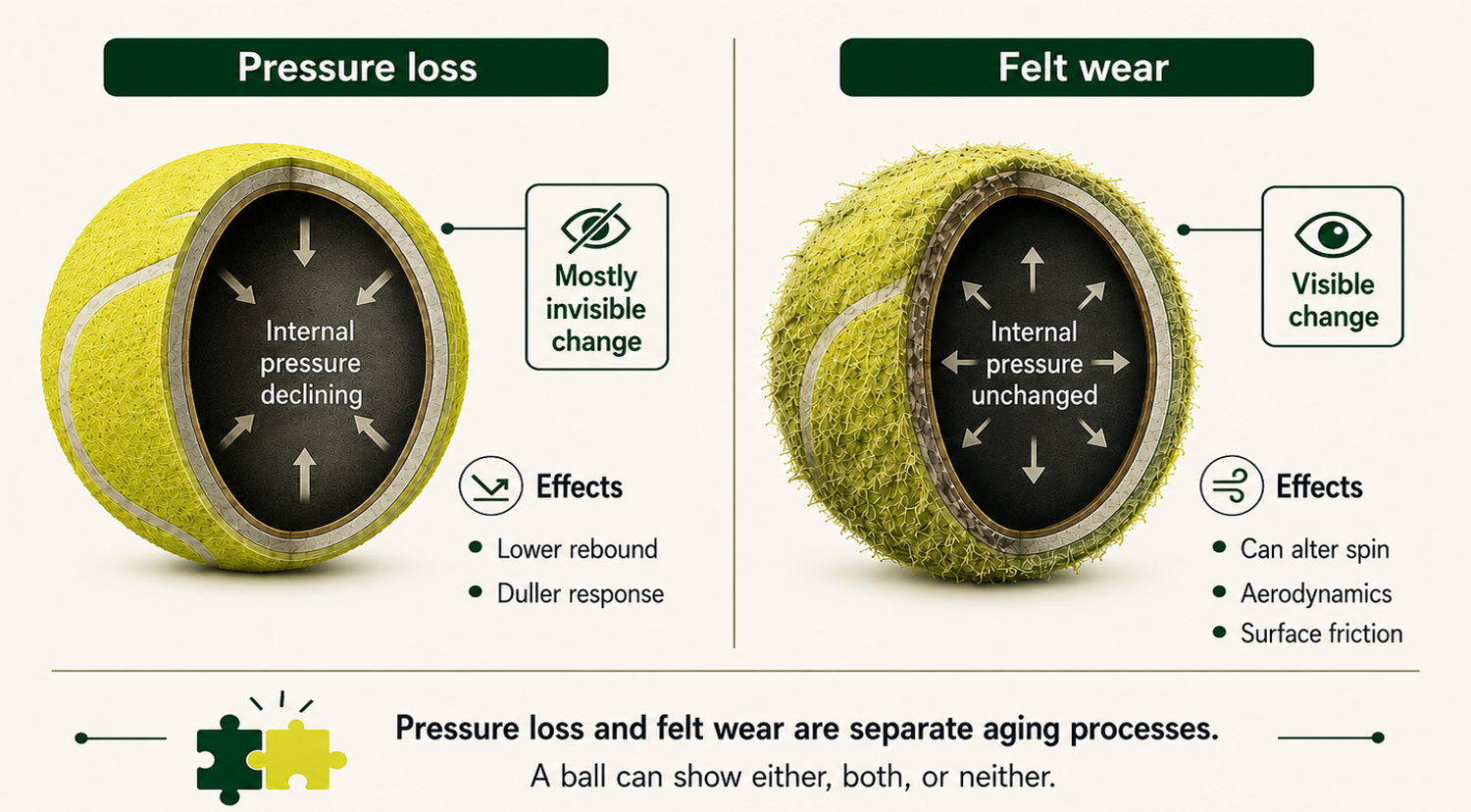
Pressure loss and felt wear are separate aging processes. A ball can show either, both, or neither.
Why do some balls lose performance faster than others?
There is no universal lifespan for a tennis or padel ball. Ball construction, temperature, altitude, playing time, and impact intensity can all influence how quickly performance changes.
- Ball construction: Rubber compounds, wall thickness, starting pressure, and manufacturing choices affect how readily gas moves through the core and how the ball responds to impacts.
- Temperature: Temperature can temporarily change how a ball behaves. Colder conditions reduce internal gas pressure and affect the response of the rubber, while warmer conditions generally produce the opposite effect. Sustained heat can also influence gas permeation over time.
- Altitude: Atmospheric pressure is lower at higher altitude, increasing the pressure difference between the ambient and the internal ball’s pressure. This is why the ITF defines separate specifications for high-altitude balls.
- Playing time and impact intensity: Every racket strike and court rebound compresses and deforms the ball. Longer sessions and harder impacts create more impact cycles, adding mechanical wear alongside pressure loss.
Grand Slam matches change balls after the first seven games and then every nine games.
This does not mean a ball is necessarily dead after nine games, but it shows how closely ball performance is controlled at the elite level.
Can the pressure and rebound of balls be restored?
Yes, the underlying physics remains identical in the opposite direction. Increasing the pressure around a ball reduces the pressure difference that drives gas outward. Elevated external pressure also drives gas back into a pressure-depleted ball, recovering internal pressure. Cubitt and Bramley investigated recovery by exposing tennis balls to elevated external pressure and measuring changes in internal pressure. Pressure maintenance slows additional pressure loss during storage. Pressure recovery is the inward movement of gas into a pressure-depleted ball under elevated external pressure.
Pressurized storage therefore preserves pressure that remains and recovers pressure already lost. This is the principle behind PressurAce. The amount of recovery depends on the ball and storage conditions. It cannot reverse felt wear, water damage, or other physical deterioration.
The Bottom Line
Tennis and padel balls do not need to look worn to lose performance. Once the can is opened, pressure loss begins and continues between sessions, while impacts contribute to this decline, and felt wear as well as rubber fatigue add separate forms of aging.
For pressurized balls, internal pressure remains one of the most important and least visible parts of performance.
For what players actually feel when that pressure fades, see What Makes a Great Tennis Ball? 5 Surprising Truths from Science.
Next in The Baseline
References
- Haake, S. J., Carré, M. J., & Goodwill, S. R. (2003). The dynamic impact characteristics of tennis balls with tennis rackets. Journal of Sports Sciences, 21(10), 839–850.
- Cubitt, A. C., & Bramley, A. N. (2006). Degradation of tennis balls and their recovery. In E. F. Moritz & S. Haake (Eds.), The Engineering of Sport 6: Volume 3—Developments for Innovation (pp. 63–68). Springer.
- International Tennis Federation. (2026). Rules of Tennis 2026. Appendix I—The Ball.
- International Padel Federation. (2026). Rules of Padel. The Ball.
- Dillon, W. E., & Simonutti, F. M. (2024). Tennis ball (U.S. Patent Application Publication No. US 2020/0070010 A1). U.S. Patent and Trademark Office.
- International Tennis Federation. (2026). ITF Approved Tennis Balls, Classified Surfaces & Recognised Courts 2026: A guide to products and test methods. Rebound—Test Method ITF TB 04/01.
- Steele, C. (2006). Tennis ball degradation [Doctoral thesis, Loughborough University].
- Davies, G. (2005). Determination and analysis of dimensions of ‘feel’ in tennis ball impacts [Doctoral thesis, Loughborough University].
Reviewed by the PressurAce team using published ITF, FIP, and sports engineering sources.
Looking to preserve ball pressure between sessions?
PressurAce restores and maintains internal pressure automatically, so your balls keep fresh-level rebound, control, and feel.